Meta Description: Learn how table tennis is played step by step in this complete guide. Covering rules, techniques, equipment tips, and more for amateurs, pros, and coaches. Boost your skills now!
Quick Answer (TL;DR)
Table tennis, also known as ping pong, is a fast-paced racket sport played on a rectangular table divided by a net. Here’s how table tennis is played step by step in a nutshell:
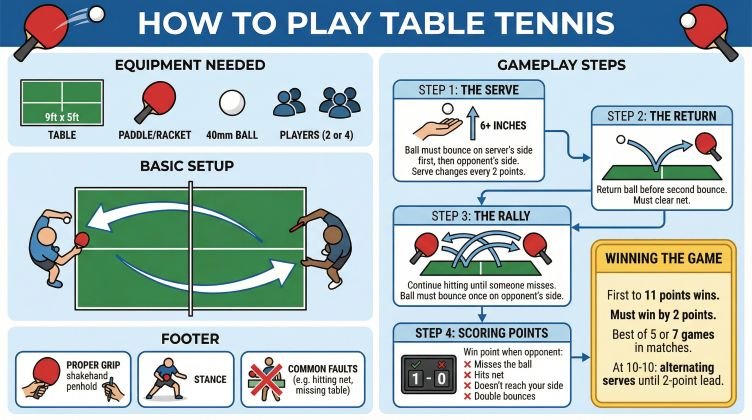
- Setup: Players stand at opposite ends of a 9 ft x 5 ft table with a 6-inch net in the middle. Each uses a paddle (racket) and a small celluloid ball.
- Serve: Toss the ball at least 6 inches from an open palm and hit it so it bounces on your side first, then over the net to the opponent’s side.
- Rally: Hit the ball back and forth, allowing one bounce on your side before returning it. The ball must clear the net and land on the opponent’s side.
- Scoring: Games go to 11 points, won by 2. Matches are best-of-5 or best-of-7. Points are scored if the opponent fails to return legally.
- End: Switch serves every 2 points; alternate sides after each game.
For beginners, start with basic grips and strokes to build control. If you’re gearing up, consider a reliable paddle like the Palio Expert 3.0 for balanced play—perfect for learning the ropes without overwhelming speed. Check it out on Amazon.
Understanding the Question
When people search for “how is table tennis played step by step?”, they’re often beginners or returning players seeking a clear, sequential breakdown of the game. This query goes beyond basic rules—it encompasses setup, techniques, strategies, and even equipment choices for effective play. Whether you’re a competitive amateur aiming to climb the rankings, a recreational player setting up a home table for family fun, a coach outfitting a club, or an aspiring pro honing your techniques, understanding the step-by-step process helps you avoid common pitfalls like illegal serves or poor paddle selection. This guide addresses that by providing a comprehensive walkthrough tailored to various skill levels and by incorporating tips on authentic equipment to address pain points such as counterfeit gear and rubber/blade mismatches.
Detailed Explanation
Table tennis combines speed, precision, and strategy. Let’s break it down step by step, from preparation to advanced play.
Equipment Needed
Before diving into play, gather the essentials. A standard table measures 274 cm (9 ft) long, 152.5 cm (5 ft) wide, and 76 cm (2.5 ft) high, with a net height of 15.25 cm (6 inches). The ball is 40mm in diameter, and paddles consist of a wooden blade covered with rubber on one or both sides.
Choosing the right paddle is crucial, especially for intermediate players frustrated by mismatched gear. Beginners might start with pre-assembled paddles, but as you advance, customize with a blade and rubbers. For instance, pair a flexible all-round blade like the Bribar Allround Professional with medium-hard rubbers for control and spin. This combo suits competitive amateurs (ages 25-55) looking to improve consistency without breaking the bank.
Pain point alert: Counterfeit equipment floods the market, especially from brands like Butterfly or DHS. Spot fakes by checking holograms, QR codes, and packaging—genuine Tenergy rubbers have orange sponges, not yellow. Avoid rip-offs by buying from reputable sellers. For a solid intermediate option, try the Killerspin JET800—great for aspiring pros (ages 16-30) with its carbon layers for added power. Get yours here.
Basic Rules and Setup
- Positioning: Players or teams (in doubles) stand at opposite ends. In singles, serve to any part of the opponent’s side; in doubles, serve diagonally from right to right.
- Grip the Paddle: Use a shakehand (like shaking hands) for versatility, or a penhold (like holding a pen) for quick wrist action. Shakehand is popular among Western players for balanced forehand/backhand play.
- Coin Toss: Decide who serves first.
Serving Step by Step
Serving sets the tone. According to ITTF rules:
- Hold the ball flat in your open palm, visible to the opponent.
- Toss it vertically at least 16 cm (6 inches) without spin.
- Strike as it falls, so it bounces on your side first, clears the net, and lands on the opponent’s side.
- No hiding the ball with your body—keep it transparent.
- Alternate serves every 2 points (or 1 at 10-10 deuce).
Common mistake: Low tosses or hidden serves lead to faults. Practice for consistency.
Rallying and Returning
Once served:
- Let the ball bounce once on your side.
- Hit it over the net to bounce on the opponent’s side.
- Continue alternating hits. Volleys (hitting before bounce) are illegal, except if the ball is obstructed.
- In doubles, alternate hits with your partner.
Focus on footwork: Stay light on your toes, pivot for forehand (dominant side) or backhand drives.
Basic Strokes
Master these fundamentals:
- Forehand Drive: Swing forward from the waist, contacting the ball at the top of the bounce for topspin.
- Backhand Push: A defensive shot, brushing under the ball for backspin control.
- Loop: Advanced spin shot for offense.
- Block: Quick return against fast balls.
For recreational families (ages 35-65), start with pushes to build rallies. Coaches’ bulk-buying for schools: Opt for durable, budget-friendly sets like PRO SPIN paddles.
Scoring and Winning
- Games to 11, must win by 2.
- Matches: Best of 5 or 7.
- Points if opponent: Misses, hits net, double-bounces, or illegal return.
- Switch sides mid-match for fairness.
At deuce (10-10), serves alternate every point.
Advanced Techniques and Strategies
For high-performance enthusiasts: Incorporate spins—topspin curves down, backspin floats. Choose rubbers based on style; softer for control (backhand), harder for speed (forehand). Blades: Thicker for stiffness, thinner for flex.
Pain point solution: Test combos—e.g., Stiga Allround blade with tacky Chinese rubbers for flex and spin. For genuine gear, verify serial numbers on DHS sites.
Key Points
- Table Setup: Standard dimensions ensure fair play.
- Legal Serve: Open palm, 6-inch toss, bounce on both sides.
- One Bounce Rule: Essential for rallies.
- Scoring Basics: 11 points, win by 2; alternate serves.
- Equipment Tips: Match blade/rubber to style—avoid counterfeits with holograms.
- Doubles Nuance: Diagonal serves, alternate hits.
- Timeouts: One per match, up to 1 minute.
Examples and Case Studies
Consider the 2024 Olympics: In the men’s singles final, China’s Fan Zhendong vs. Sweden’s Truls Moregard showcased step-by-step mastery. Fan’s precise serves (step 2) led to aggressive loops, forcing errors. Moregard countered with backhand pushes but lost rallies due to spin mismatches—highlighting the importance of rubber choice.
Case study: A suburban family (target audience) sets up a home table. They start with basic serves but struggle with control. Switching to the Palio Legend bat (intermediate-friendly) improved spins, turning games into fun bonding sessions. Upgrade your setup with this paddle.
Another: A club coach buys in bulk for teens. Using genuine Butterfly blades avoided the poor durability of fakes, boosting training efficiency.
Expert Insights
Pro coach Tom Lodziak recommends all-around blades for intermediates: “Flex helps with hard tacky rubbers like H3 for spin.” On fakes: “Check sponge color and logos—fakes lack crispness.”
For aspiring pros: “Softer rubbers on backhand for touch; fast blades mid-distance.” Budget-conscious institutions: Prioritize durable, verified gear to cut long-term costs.
Additional Resources
- ITTF Handbook: Download for full rules.
- Videos: YouTube’s “Basic Rules of Table Tennis” for visuals.
- Reviews: Check Megaspin for blade guides.
- Authenticity Tools: Butterfly’s QR verification.
For in-depth rubber selection: STIGA’s guide.
Conclusion
Mastering table tennis step by step transforms it from casual fun into a competitive edge. From setup and serves to advanced spins, focus on fundamentals while addressing equipment pain points, such as authentic rubber/blade combos. Whether you’re a recreational player, coach, or pro hopeful, consistent practice with quality gear pays off. Ready to elevate? Grab the PRO SPIN Carbon Set for versatile play—ideal for families or clubs. Shop now. Hit the table and enjoy!
Frequently Asked Questions
Q: What is the difference between ping pong and table tennis?
A: They’re the same sport; “ping pong” is casual, while “table tennis” is the official name used in competitions.
Q: How do I choose the right rubber for my blade?
A: Match to your style—softer for control, harder for speed. Test combos like Xiom Intro for beginners.
Q: Can I use any paddle in official games?
A: Paddles must have ITTF-approved rubbers; check for logos.
Q: How to avoid counterfeit equipment?
A: Verify holograms, serial numbers, and buy from authorized dealers. Fakes often have dull logos or wrong sponges.
Q: What’s the best paddle for intermediate players?
A: The Butterfly Petr Korbel with balanced rubbers—great from beginner to intermediate. Explore options.
Q: How many serves per player?
A: Two consecutive, then switch, except at deuce.
Q: Is there a time limit per point?
A: No, but the expedited rule kicks in after 10 minutes if under 18 points total.
Q: Can the ball hit the edge?
A: Yes, edges count as in.
Q: What’s a good home table for families?
A: Look for foldable models with playback mode for solo practice.
Q: How to improve spin?
A: Use tacky rubbers and brush the ball—practice loops daily.