Meta Description: Choosing between indoor & outdoor ping pong tables? Our guide covers space, materials, budget & setup for a perfect home recreational table tennis.
1. Introduction
The satisfying ping of the ball, the quick dash to the side, the friendly rivalry—table tennis is a timeless source of fun, exercise, and connection. Whether you’re a home office worker craving an active break, a parent seeking a screen-free family activity, or a retiree looking for a social sport, a recreational table tennis table can be a fantastic investment.
But as soon as you start shopping, a critical question appears: Indoor or Outdoor? It’s not just about where it goes; your choice affects materials, durability, play quality, and value. If you choose wrong, you might get a warped surface in the sun, a bulky table that squeezes your space, or a bounce that drains the fun.
This guide provides clear recommendations for choosing between indoor and outdoor tables. You’ll learn about the key differences, how to evaluate your space and needs, and which features matter most—so you can confidently select the best table for your situation and enjoy years of play.
2. Understanding the Basics
Before diving into specifics, let’s clarify the core distinction and define what we mean by “recreational” play.
The Core Difference: It’s All About the Top
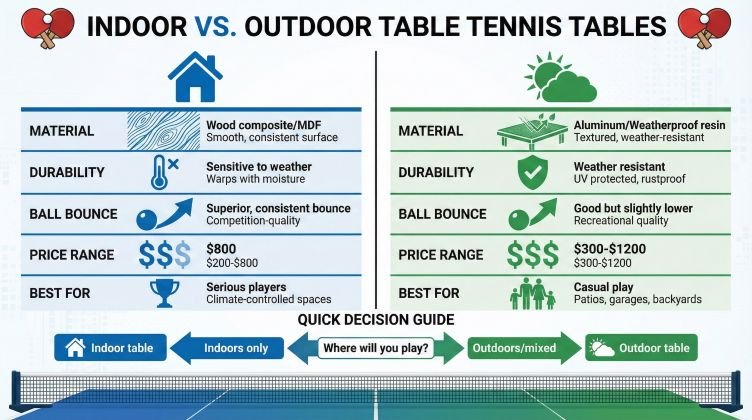
- Indoor Tables: Feature a smooth, laminated wooden surface (typically medium-density fiberboard or MDF) on a particleboard core. This provides consistent, high bounce and ball control, as defined by the official International Table Tennis Federation (ITTF) standards. The laminate protects the wood from moisture but is not waterproof.
- Outdoor Tables: The top is synthetic, made from aluminum composite, polymer, or resin. These materials are UV-resistant, waterproof, and don’t warp or rust. The bounce is different—often faster and higher-pitched. These tables are built to handle rain, sun, and temperature swings.
What is “Recreational Table Tennis”?
For this guide, we’re not talking about professional tournament play. Recreational table tennis is about casual enjoyment, family fun, and friendly competition. The priorities are durability, ease of setup, cost-effectiveness, and consistent enough performance for enjoyable rallies. You might be using it for coffee break matches, weekend tournaments with the kids, or backyard social games. The best table for you is the one you use the most.
3. Key Considerations
Choosing your champion table involves weighing these five crucial factors.
1. Location & Environment
This is your starting point. Be brutally honest with your assessment.
- Indoor: Do you have a dedicated room, a large garage, a finished basement, or an open area? Measure the table size (usually 9’ x 5’) and the playing area. You need at least 3-4 feet at each end and 1.5-2 feet on each side for movement. Check ceiling height too.
- Outdoor: Will the table live on a patio, under a pergola, or fully exposed in the yard? Even “weatherproof” tables benefit from some cover. Direct, constant sunlight can fade colors and make the surface hot to the touch. Wind is also a factor for ball control.
2. Table Type & Materials
- Indoor Tables:
- Pros: Superior ball bounce and spin response. Quieter play. Generally lighter and easier to move (for non-foldable types). Wider range of designs and finishes.
- Cons: Vulnerable to moisture, humidity, and direct sunlight. Will warp if left outdoors.
- Outdoor Tables:
- Pros: Virtually indestructible in the elements. Rust-resistant aluminum frames and galvanized steel nets are standard. It can often be hosed down. No worry about spills.
- Cons: Play experience falls short of indoor standards. The surface can be slicker or louder. Typically heavier and more industrial in appearance.
3. Space & Storage: The Foldability Factor
This is a major pain point solver.
- Full-Size, Non-Folding: Offers the most stable, permanent play experience. Best for dedicated spaces.
- Fold-in-Half (Playback Mode): The most common recreational style. One half folds up for solo practice against a built-in playback surface. Folds vertically for compact wall storage.
- Fold-in-Half (No Playback): Similar storage, but without the solo practice feature.
- Mini & Compact Tables: Smaller surfaces (often 6’ long) designed for tight spaces like apartments or dorm rooms. Sacrifice full-court play for accessibility.
Maximize a small garage or game room with a space-saving champion. The JOOLA Inside 250 Compact Table offers a great fold-away design without sacrificing a true playing surface. Check current prices and see if it fits your space.
4. Budget & Value
- Budget (<$300): Typically lighter indoor tables or smaller outdoor models. Good for very casual play. Nets and frames may be less durable.
- Mid-Range ($300 – $800): The sweet spot for recreational players. Here you’ll find sturdy indoor tables with good playback features, as well as robust outdoor tables from reputable brands.
- High-End ($800+): Feature competition-grade indoor surfaces (often 25mm+ thick), superior undercarriage stability, and professional-grade outdoor models with advanced composite tops.
5. Accessories Matter: Nets, Balls & Paddles
A great table is let down by poor accessories.
- Nets & Post Sets: Look for screw-down clamps for tension, not spring-loaded. For outdoor, metal is a must. A sagging net ruins the game.
- Balls: The star rating indicates quality consistency. For recreational play, 40mm 3-star balls are worth the small premium—they are more round, balanced, and durable than 1-star balls, leading to longer, more predictable rallies.
- Paddles: Skip the cheap “sandpaper” paddles that come bundled. Buy a pair of solid recreational paddles with sponge and rubber surfaces. You’ll notice a big jump in control and spin.
Elevate your game instantly. A set of Stiga 3-Star Ping Pong Balls and Butterfly Prelude Paddles delivers professional-grade performance, making it perfect for casual players looking to improve their play.
4. Step-by-Step Guide to Choosing Your Table
Follow this process to make a confident decision.
Step 1: The Location Audit.
Grab a tape measure. For indoor, measure your intended floor space and ceiling height. For outdoor, assess the ground (level concrete or paving is ideal) and sun/wind exposure. Write down your maximum dimensions.
Step 2: Define Your Primary Use.
Is this for solo practice on work breaks? Loud family tournaments? Gentle games with grandparents? Your main use determines what’s most important: playback mode, durability, or a classic indoor feel.
Step 3: Set Your Realistic Budget.
Include $75-$150 for good paddles, balls, and maybe a cover. It’s better to get a mid-range table with good gear than a top-tier table with poor accessories.
Step 4: Research & Shortlist.
Filter online searches by your location (indoor/outdoor), size, and foldability needs. Read reviews focusing on ease of setup, stability, and bounce consistency over time. Brands like STIGA, JOOLA, and Cornilleau are reliable in the recreational space.
Step 5: Evaluate Key Specs.
Look for:
- Table Top Thickness: For indoor, 16mm+ is good for recreational play; 19mm+ is excellent. For outdoor use, the material type (e.g., “aluminum composite”) is more critical.
- Frame & Leg Construction: Thick, powder-coated steel legs with adjustable levelers ensure stability.
- Wheel & Storage System: Are the wheels robust? Does it fold and roll away easily?
For the ultimate backyard games center, the STIGA XTR Outdoor Table is built to last with a patented weather-resistant surface. See its latest specs and seasonal pricing options.
5. Expert Tips
- The Garage “Hybrid” Solution: If you have a dry, climate-controlled garage, you can use an indoor table and get the best of both worlds—superior play and protection. It’s often the ideal compromise.
- Never Store an Indoor Table on Its Side: This can warp the top over time. Always store it folded vertically or flat.
- Cover It Up: Even an outdoor table benefits from a fitted vinyl cover. It protects from UV degradation, bird droppings, and dust, prolonging its life and appearance.
- Surface Feel Test: If possible, visit a sporting goods store. Gently press on the table surface. A high-quality indoor top will feel solid and dense. A cheap one may feel hollow or flex slightly.
6. Common Mistakes to Avoid
- Prioritizing Price Over Playability: The absolute cheapest tables often have poor bounce and frustrating nets. They can turn people off the game.
- Underestimating Space: Crowding the table into a tight space makes the game unplayable and can cause wall damage. Measure diligently.
- Using the Wrong Table in the Wrong Place: Placing an indoor table in a sunroom or screened porch with humidity fluctuations will destroy it.
- Ignoring the Subfloor: An outdoor table on uneven grass or gravel will never be level or stable, making play frustrating.
- Neglecting Accessories: Using worn-out balls or a sagging net degrades the experience more than the table’s quality.
Protect your investment year-round. A heavy-duty, fitted Universal Ping Pong Table Cover shields your table from dust, sun, and moisture, keeping it ready for a game.
7. Conclusion
The choice between an indoor and an outdoor recreational table tennis table ultimately comes down to your lifestyle, available space, and your commitment to the game. **For the authentic ping pong experience—**with its precise spin and controlled bounce—a dedicated indoor space with a quality wood-surface table is unbeatable. For worry-free, anytime fun that withstands the elements and hosts barbecues and family gatherings, a rugged outdoor table is the clear champion.
Remember, the best table is the one that sees constant use. By carefully considering your environment, accurately measuring your space, and investing in solid accessories, you’re not just buying a piece of sports equipment. You’re investing in health, laughter, and countless hours of shared enjoyment. Now, who’s ready to serve?
Ready to find your perfect match? Browse the curated selection of top-rated indoor and outdoor tables, paddles, and sets at Dick’s Sporting Goods to compare models and find the best deal for your game room or backyard.