Meta Description
Discover space-saving recreational table tennis options for small homes. This guide covers mini tables, conversion tops, equipment tips, and more for families, students, and retirees seeking fun, low-impact play.
Introduction
In today’s compact living spaces, finding ways to incorporate fun, active recreation without sacrificing room is a common challenge. Recreational table tennis, often called ping pong, offers an exciting solution—it’s a low-impact sport that promotes physical activity, sharpens reflexes, and fosters social interaction. Whether you’re a home office worker taking a quick break, a suburban parent organizing family game nights, a university student in a cramped dorm, or a retiree looking for gentle exercise, space-saving options make it possible to enjoy this game indoors.
To overcome these challenges, this guide addresses pain points directly and explores innovative products for small home setups in 2026. Whether you struggle with limited space, durability concerns, or equipment confusion, we’ll walk you through the best solutions. From foldable mini tables to conversion tops that transform your dining table, you’ll learn how to create a setup that’s practical, affordable, and enjoyable. Let’s start by defining the basic elements you’ll need.
Understanding the Basics
Recreational table tennis is the casual version of the Olympic sport, focusing on fun rather than competitive precision. Unlike professional play with strict ITTF regulations, recreational setups prioritize ease, portability, and family-friendly features. At its core, you need four essentials: a table (or surface), a net, paddles (also called rackets or bats), and balls.
The table forms the foundation—standard ones are 9 feet long, but space-saving variants shrink this to 6-7 feet or less for mini models. Nets are typically 6 inches high and clamp onto the table edges; retractable or clip-on versions are ideal for small homes. Paddles, which are also known as rackets or bats, consist of a wooden blade covered in rubber for grip and spin. Recreational paddles usually have pips-out (small rubber bumps that face outward) for better control. Balls are plastic spheres about 40mm in diameter, rated by stars: 1-star for basic play (less consistent bounce), 2-star for intermediate, and 3-star for high-quality, even bounce suitable for casual yet serious fun.
Now that you understand the basics and how different users benefit, let’s examine several key considerations for setting up table tennis in a compact living space.
Key Considerations
When selecting space-saving recreational table tennis options, several factors come into play to address pain points like space limitations and equipment durability.
Space Constraints
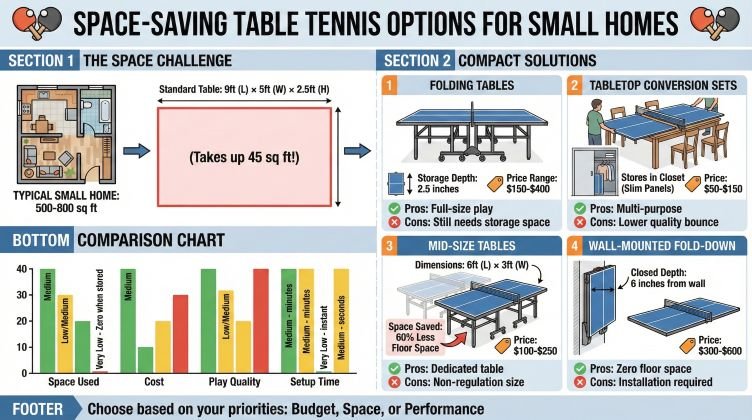
Measure your available area first—aim for at least 10-15 feet of play space around the table to swing paddles freely. For tiny apartments or dorms, mini tables (around 70×40 inches) or tabletop conversion kits are perfect, folding down to under 2 feet for storage under a bed or in a closet. Foldable models like those from STIGA or JOOLA offer compact storage without compromising playability.
Durability and Bounce
Look for tables with MDF (medium-density fiberboard) tops at least 12-15mm thick for decent bounce—thinner ones feel cheap and inconsistent. Nets should be sturdy nylon with adjustable tension to prevent sagging. Paddles need quality rubber; avoid flimsy sets that peel after a few games. For balls, 3-star-rated ones (e.g., from Butterfly or STIGA) offer superior sphericity and bounce, reducing frustration during play.
Budget and Portability
Entry-level setups start at $100-300, with premium options up to $500 for weatherproof models. Prioritize portability: wheels on foldable tables make moving easy for retirees or students. Consider multi-use items, like conversion tops that fit over pool or dining tables, maximizing value in small homes.
Audience-Specific Needs
With these audience-specific needs in mind, reviewing the following step-by-step guide will help you select, set up, and enjoy your perfect space-saving table tennis solution.
Step-by-Step Guide
Ready to begin? Setting up recreational table tennis in a small home is straightforward with the right approach. Follow these steps to overcome space and equipment hurdles and start playing.
Step 1: Assess Your Space and Needs
Evaluate your room—garage, living area, or even a balcony. Measure dimensions and consider traffic flow. For families, ensure it’s child-accessible; for students, prioritize storability. Identify your play style: casual rallies or semi-competitive? This guides your budget ($150-$400 for basics).
Step 2: Choose the Table Type
Opt for space-savers:
- Mini Tables: Compact (e.g., STIGA Space Saver at 71×41 inches), foldable for easy storage. Ideal for dorms or apartments.
- Foldable Full-Size: Like JOOLA Inside, which halves for storage against a wall.
- Conversion Tops: Place over existing tables (dining or pool); EastPoint or RayChee models fold into quarters.
The STIGA Space Saver Table is a versatile option for compact, enjoyable play.
Step 3: Select Paddles, Nets, and Balls
Pick paddles with good grip—STIGA’s recreational sets offer durable rubber. For nets, choose clamp-on retractables for versatility. Balls: Start with a 3-star for better bounce; avoid a 1-star for consistency. Packs of 6-12 suffice for starters.
Step 4: Assemble and Set Up
Most modern tables assemble in 10-30 minutes—no tools needed for pre-assembled models. Secure the net, place it on a flat surface, and test the bounce with a ball drop (should rebound 23-26cm from a 30cm drop). Add protective covers for longevity.
Step 5: Test and Maintain
Play a practice game to adjust. Clean surfaces with mild soap, store away from moisture, and replace worn rubber on paddles annually. This ensures durability and addresses common pain points.
Once you master setup, consider upgrading your game with JOOLA’s durable paddles and 3-star balls for an enhanced experience. Next, let’s look at insider tips to get even more from your setup. Expert Tips
To maximize enjoyment:
- Improve Bounce: Use a mat under mini tables for stability.
- Family Play: For parents, incorporate rule variations like “no-spin” for kids.
- Storage Hacks: Wall-mount hooks for paddles; vertical storage for foldables.
- Ball Selection: Mix 1-star for training (cheaper) and 3-star for games—3-star offers 80-90% consistency vs. 50% for 1-star.
- Health Boost: Retirees, aim for 20-minute sessions to enhance balance; workers, use as a desk break to reduce sedentary time.
- Customization: Add LED nets for night play in small spaces.
- Maintenance: Wipe paddles after use to preserve rubber; store balls in a cool place to prevent warping.
These tips, drawn from 2026 trends like eco-friendly materials, make your setup last longer and more engaging.
Try Butterfly’s premium nets for high-bounce reliability .
Common Mistakes
Avoid these pitfalls to prevent disappointment:
- Ignoring Space Measurements: Buying a full-size table for a tiny room leads to cramped play—always measure twice.
- Skimping on Quality: Cheap nets sag, and low-end paddles lack grip, ruining fun. Invest in mid-range for durability.
- Ball Confusion: Choosing only 1-star balls results in erratic bounce; mix with 3-star for a better experience.
- Overlooking Assembly: Pre-assembled is best for beginners—complex kits frustrate students or retirees.
- Poor Storage: Leaving tables exposed can cause warping; use covers and store them upright.
- Not Testing Bounce: Skip the drop test, and you might end up with a dead surface.
- Forgetting Accessories: No spare balls or proper lighting leads to interrupted games.
By steering clear of these pitfalls, you’ll enjoy seamless recreational table tennis without common frustrations. To wrap up, here are final thoughts to help you take the next step toward your ideal setup. Avoid mistakes with GoSports’ midsize foldable table.
Stock up on STIGA’s 3-star balls for consistent play.
Conclusion
Space-saving recreational table tennis options empower anyone in a small home to embrace this versatile sport. From mini tables that tuck away effortlessly to conversion tops that repurpose existing furniture, these solutions tackle limited space, durability concerns, and equipment confusion head-on. Tailored for home office workers, suburban parents, university students, and retirees, they offer active, social fun without overwhelming your living area.
Start small—assess your space, pick a reliable setup, and incorporate expert tips for longevity. With the right gear, like JOOLA or STIGA, you’ll create lasting memories and reap health benefits. Ready to serve? Dive in and transform your home into a ping pong paradise!