Meta Description
Discover how to pick the ideal paddle for recreational table tennis. This guide covers the basics, key factors, top recommendations, and tips for overcoming common challenges, such as space constraints and equipment durability.
1. Introduction
In the hustle of daily life, finding a fun, low-impact activity that fits into your routine can be a game-changer. Recreational table tennis, often called ping pong, offers just that—whether you’re a home office worker aged 30-55, squeezing in active breaks, a suburban parent aged 35-50, organizing family game nights, a university student aged 18-25, navigating dorm space constraints, or a retiree aged 60+, enjoying social, gentle exercise. It’s an accessible sport that promotes quick reflexes, coordination, and laughter, all without needing a massive setup.
However, choosing the right paddle can make or break your experience. Many enthusiasts struggle with limited space for full-size tables in homes or garages, finding durable nets and paddles that provide consistent bounce for casual play, or deciphering ball quality like 1-star versus 3-star ratings. A mismatched paddle can lead to frustration, inconsistent shots, and even minor injuries due to poor grip or improper weight.
This comprehensive guide will walk you through selecting a paddle tailored to recreational play and address these pain points head-on. By focusing on key elements like grip, materials, and performance, you’ll elevate your games from casual rallies to engaging matches. Let’s explore how the right paddle can transform recreational table tennis into your go-to pastime.
2. Understanding the Basics
Before diving into selections, it’s crucial to understand what makes up a table tennis paddle (also known as a racket or bat). Unlike professional setups, recreational paddles prioritize ease, durability, and fun over elite speed.
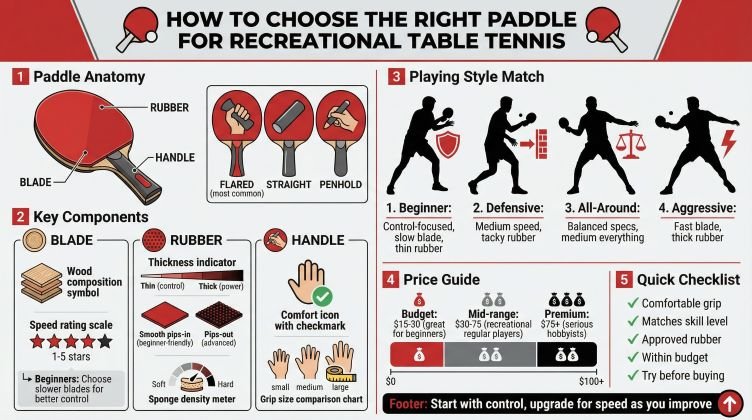
A standard paddle consists of three main parts:
- Blade: The main part is made of layers of wood or other materials. A thicker blade makes the paddle hit harder but is less easy to control, which can be fun for strong hits.
- Rubber: The covering on the blade. Smooth rubber helps you balance spin and control. Bumpy or textured rubber makes it easier to add spin. The soft part under the rubber (usually 1.5-2.0mm thick for most casual players) affects how high the ball bounces and how fast it moves.
- Handle/Grip: Shapes like flared (to prevent slipping), anatomic (contoured for comfort), or straight influence how the paddle feels in your hand. The shakehand grip (like shaking hands) is most versatile, while the penhold grip suits precise control.
For casual table tennis, pre-made paddles with ratings for speed, spin, and control (on a scale from 1-10) work fine. Beginners can try paddles that are easier to control (higher ratings, like 8-10), while those with more experience might want ones that add more spin (ratings like 7-9) for exciting rallies.
This foundation ensures your paddle matches your space and style, avoiding issues like low bounce from cheap rubbers.
3. Key Considerations
Selecting a paddle involves balancing your needs with practical factors. Here’s what to evaluate:
3.1 Playing Style and Skill Level
Assess if you’re defensive (focusing on returns and control) or offensive (emphasizing speed and spin). Home office workers might prefer lightweight paddles for quick sessions, while parents need durable ones for family use. Beginners should opt for forgiving paddles with high control; experienced players can handle faster models.
3.2 Grip and Handle Type
Comfort is key in limited spaces. Flared handles suit most, preventing slips during energetic play. Test the shakehand for flexibility, or the penhold for precision. Weight (75-85g for attackers, heavier for defenders) affects maneuverability—lighter options ease elbow strain for retirees.
3.3 Blade Material and Composition
Wood blades (e.g., balsa for lightness) offer good feedback; carbon-infused blades add speed but reduce feel. For recreational durability, choose 5-ply blades for balance. Thickness impacts stiffness—thinner for control in small areas.
3.4 Rubber and Sponge Quality
Rubber type matters: Tacky for spin control, non-tacky for speed. Sponge thickness (1.5 mm+) enhances bounce, addressing low-quality ball issues. ITTF-approved rubbers ensure consistency.
3.5 Weight, Speed, Spin, and Control Ratings
Aim for paddles rated 6-8 for speed/spin for fun, and 8-10 for control. Lighter paddles (under 180g total) suit space-constrained students.
3.6 Durability and Price
Budget $20-50 for entry-level; $50-100 for premium recreational. Weather-resistant for outdoor garages. Avoid cheap plastics that wear quickly.
These considerations address pain points such as inconsistent bounce and the need for enjoyable play.
4. Step-by-Step Guide
Follow this process to find your ideal paddle:
4.1 Assess Your Needs
Identify pain points: Space limits? Opt for compact, lightweight. Family play? Durable rubbers. Rate your level—beginner (control-focused) or intermediate (spin-added).
4.2 Research Top Options
Based on 2026 reviews, here are standout recreational paddles:
- STIGA Pro Carbon: Recommended for balanced play, as its carbon layers increase speed. Suitable for parents and students seeking a versatile paddle.
- PRO-SPIN Carbon: Suggested for affordable, high-spin performance. Best for home offices or players preferring value and reliable spin.
- Butterfly 401: Recommended for retirees or those seeking control-oriented play, as its tacky rubber enhances precision.
- Killerspin JET200: Advised for beginners, offering durability for frequent use in dorms and a user-friendly design.
- JOOLA SpinForce 300: Recommended for those focusing on spin, though durability should be checked before purchase.
Compare them:
| Paddle | Best For | Price Range | Key Ratings (Speed/Spin/Control) |
| STIGA Pro Carbon | All-around | $50-70 | 8/9/8 |
| PRO-SPIN Carbon | Budget spin | $30-50 | 7/8/9 |
| Butterfly 401 | Control | $40-60 | 6/7/10 |
| Killerspin JET200 | Beginners | $20-40 | 5/6/9 |
| JOOLA SpinForce 300 | Intermediate | $30-50 | 7/8/8 |
If you’re ready to upgrade, consider the STIGA Pro Carbon for enhanced family games.
4.3 Test and Demo
Visit stores or use online trials. Swing for comfort, test bounce with 3-star balls.
4.4 Evaluate Accessories
Pair with durable nets and balls—3-star for consistent play.
4.5 Purchase and Maintain
Buy from reputable sources. Clean rubber regularly for longevity.
Consider the PRO-SPIN Carbon set—well-suited for casual rallies.
This guide helps you find a paddle that fits your lifestyle.
5. Expert Tips
Maximize your choice with these insights:
- Match to Playstyle: Defensive? High-control rubber. Offensive? Thicker sponge for power.
- Start Balanced: Beginners, choose an all-around blade like the Stiga Allround Evolution.
- Grip Comfort: Flared for security in fast games.
- Rubber Thickness: 1.5-2mm for recreational bounce.
- Weight Check: Lighter for quick breaks, heavier for stability.
- ITTF Approval: Ensures quality for social play.
Explore Butterfly 401 for superior control.
These tips enhance enjoyment in constrained spaces.
6. Common Mistakes
Steer clear of these pitfalls:
6.1 Ignoring Play Style
Buying without considering defense vs. offense leads to a mismatch. Assess first.
6.2 Choosing Cheap Premades
Low-quality wood and thin rubber hinder learning. Invest in mid-range.
6.3 Jumping to Advanced Paddles
Intermediates often skip to fast blades, losing control. Progress gradually.
6.4 Prioritizing Price Over Fit
Expensive brands aren’t always the best; focus on needs.
6.5 Neglecting Grip
Wrong grip causes slips or discomfort. Test multiple.
Avoiding these ensures lasting satisfaction.
7. Conclusion
Choosing the right paddle for recreational table tennis unlocks endless fun, whether breaking from work, bonding with family, or staying active in retirement. By understanding the basics, considering key factors, and following our step-by-step guide, you’ll overcome challenges such as space limitations and equipment durability.
Top picks like STIGA Pro Carbon or PRO-SPIN offer balance for all. Start today—assess, research, and play!
The Killerspin JET200 offers beginner-friendly ease;
The JOOLA SpinForce excels for those seeking spin-focused play
With the right paddle, every rally is a highlight. Enjoy table tennis as your go-to activity in 2026.